Generative AI + Blender Workflow Evolution: Which Stages Are Production-Stable Now? (Practical Notes)
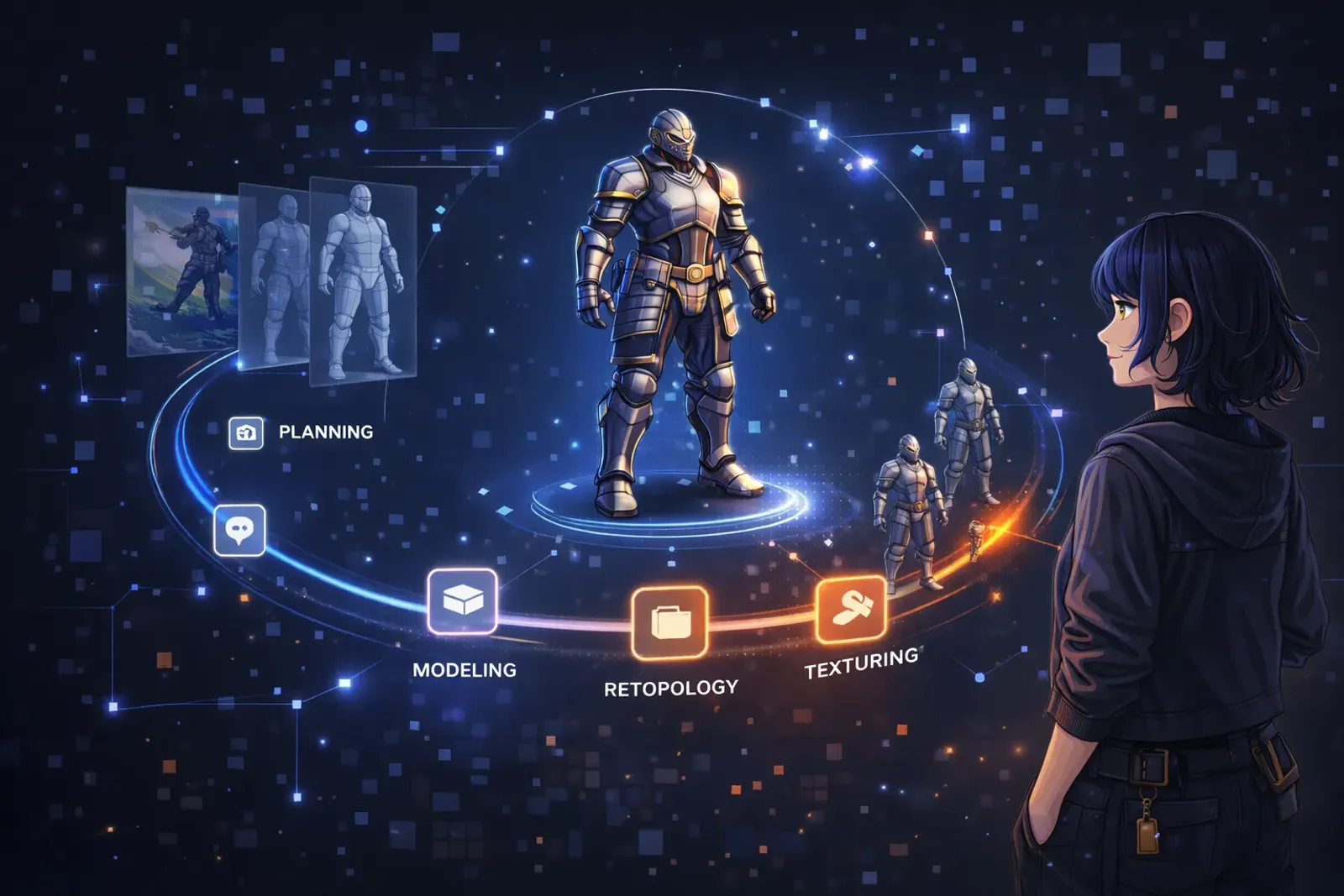
Generative AI + Blender Workflow Evolution: Which Stages Are Production-Stable Now? (Practical Notes)
This is not a tool showcase. It is a production note for game art and technical art teams: in 2026, which stages of a generative AI + Blender workflow are stable enough for production, and which stages still carry high rework risk.
The core conclusion is straightforward: AI is now reliable for early and mid-stage throughput expansion, but final quality and ship readiness still depend on Blender-side standards and human control.
A simple model of the most stable division of labor
You can split the pipeline into three layers:
- AI layer (speed): concept variants, first-pass mesh ideas, material directions
- Blender layer (control): topology, UVs, rigging, node organization, asset standardization
- Engine layer (delivery): LOD, collision, performance checks, final integration and QA
Pipelines designed as “AI accelerates, Blender converges” are consistently more successful than full automation.
Five stages already stable for production use
1) Concept exploration and visual direction variants
This is currently the most mature stage. AI can produce direction options quickly and narrow visual decisions early.
Production condition: define style vocabulary, banned tokens, and reference boards before generation.
2) First-pass drafts for non-hero environment assets
Repeatable, lower-risk assets (environment props, filler objects) are strong candidates for AI drafts plus Blender cleanup.
Production condition: use a fixed cleanup checklist for topology, naming, pivot, scale, and material slots.
3) Material direction drafts and early look-dev testing
AI-assisted material ideation can speed up style comparison if final materials are consolidated in Blender.
Production condition: final materials must be maintainable node systems, not one-off patchwork.
4) Procedural variation expansion with Geometry Nodes
AI provides base forms while Blender’s Geometry Nodes expands controlled variants for medium-scale content.
Production condition: variation rules must be repeatable and batch-updatable.
5) Marketing previews and proposal visuals
Before final assets are done, AI + Blender is highly effective for visual pitching and cross-team alignment.
Production condition: maintain a clear boundary between preview assets and ship-ready assets.
Four high-risk stages that still require manual control
1) Hero characters and high-identity assets
Character consistency, expression control, and style stability remain too critical for fully automated outputs.
2) Rigging and deformation quality
Even if static appearance looks usable, skeletons, skin weights, and deformation often fail under real animation stress.
3) Strict engine delivery specifications
Naming, LOD, collision, material slots, and rig hierarchy inconsistencies still scale into expensive integration issues.
4) Copyright and provenance traceability
Commercial rights, usage scope, and audit-ready source records are non-negotiable and cannot be replaced by speed.
A practical “production-ready” validation checklist
To make AI + Blender truly repeatable, teams should define at least these checkpoints:
- Geometry: no unexpected breakage, consistent normals, polygon budgets respected
- Topology: supports intended animation/deformation behavior
- UVs: no accidental overlap (unless intentional), consistent texel density
- Materials: slot, naming, and texture-size compliance
- File structure: naming, hierarchy, and version metadata machine-readable
- Engine validation: no major visual mismatch after import
- Compliance records: source, tool version, and prompt strategy traceable
Meeting this checklist is what turns “it works visually” into “it ships reliably.”
Adoption strategy: start small, standardize early, scale gradually
- Run a two-week pilot on low-risk assets.
- Modularize Blender cleanup steps as reusable templates.
- Define red-line assets that never go full-auto.
- Track weekly rework sources with simple metrics.
- Bring legal/production in early, not at the end.
Conclusion
Generative AI + Blender has evolved from a promising experiment into a production-capable workflow, but only when treated as a standards-driven pipeline rather than a random creativity shortcut.
In 2026, the real advantage is not who generates fastest, but who consistently transforms generated outputs into shippable, maintainable, and scalable assets.