Meta Horizon Create and Horizon Studio: A Mobile Game From a Prompt, but Whose Platform Keeps It?
Meta Horizon Create and Horizon Studio: A Mobile Game From a Prompt, but Whose Platform Keeps It?
Current Observation / 現況觀察
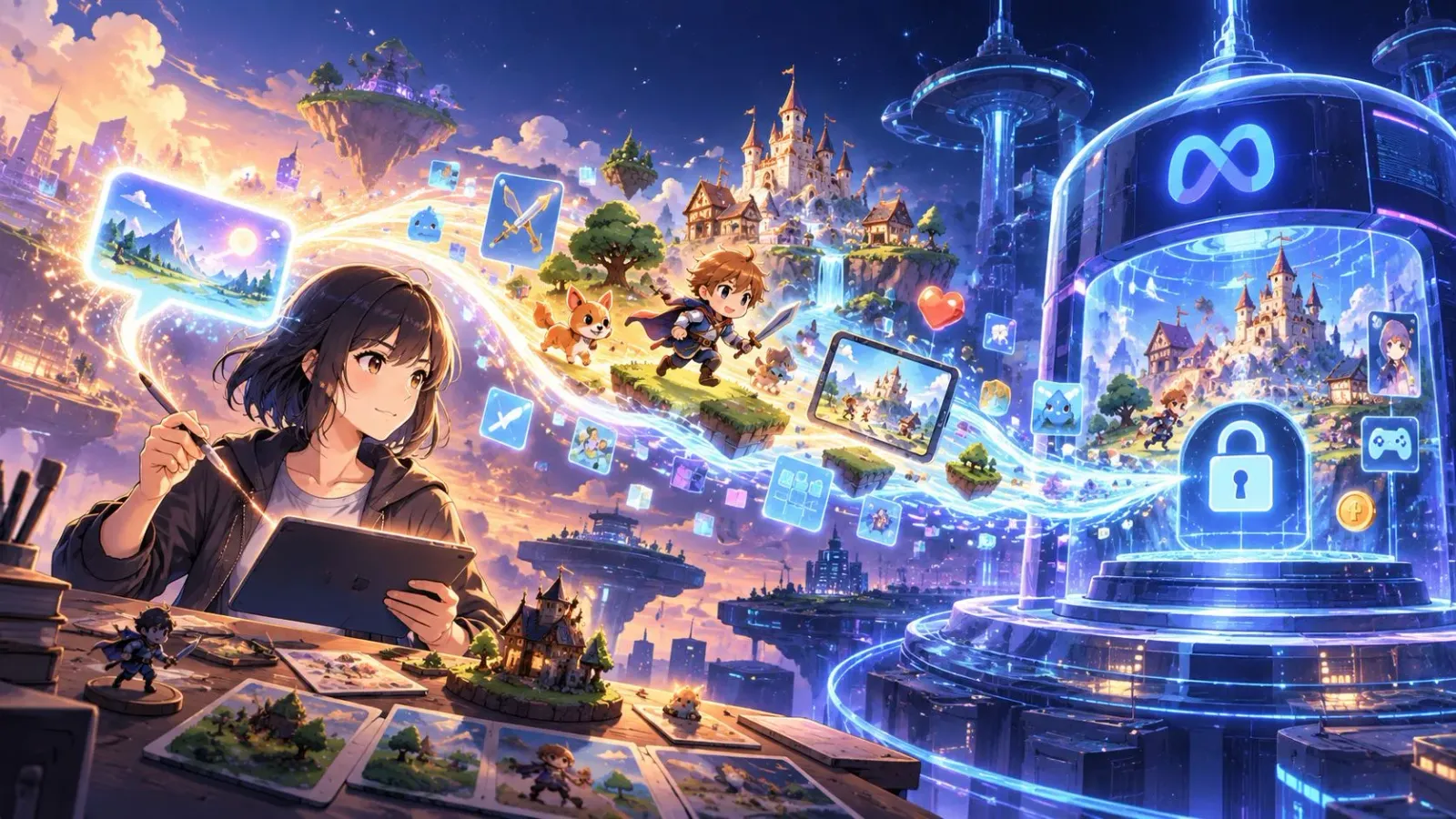
At Connect, Meta announced two new game creation tools, Horizon Create and Horizon Studio, and opened an early access waitlist (the Meta developer blog recap is dated September 24, 2026). According to Meta, both are built on the “agentic creation” capabilities of the Meta Horizon Engine: describe the game you want in your own words and the engine produces a complete 2D or 3D mobile game, including progression systems, balanced difficulty, art direction and multiplayer, with every element adjustable afterwards. Meta also says no game engine or coding is required.
Horizon Create is a standalone mobile app. You start from a text prompt or a ready-made template, then change art style, characters, story and progression by describing what you want. Builds run in the background, so you can play something else and get a notification when it’s ready to playtest. It also supports multiple projects at once.
Horizon Studio runs in the browser, with nothing to install and no gaming PC required. It offers the same prompting flow plus visual editing: arrange the scene directly, browse and swap individual assets, tune script parameters and shape spatial layouts by hand. Meta also mentions sliders, dropdowns and typed parameters, and claims a single prompt can restyle a scene’s environment, characters and lighting.
The two tools share a backend, so projects move in either direction with their assets, systems and iteration history, and you can start a new project directly in Studio. Once published, games are eligible for native distribution on Facebook, Instagram and Horizon. Meta’s example: someone scrolling Instagram taps a clip of your game and is in a multiplayer session within seconds, with no download or redirect.
Both tools are still being tested with Meta’s creator community, early access is rolling out gradually, and broader access is only promised “soon”. There is no release date (Inven Global reports the same).
Background Analysis / 背景分析
As RuntimeWire notes, Meta already mentioned Horizon Studio at Connect 2025, back then framed as a tool for building worlds on the new Horizon Engine. This year the pitch changed: it explicitly talks about generating mobile games, puts the phone first, and wires publishing into Facebook and Instagram. The focus moved from “a more capable editor for creators” to “the shortest path from idea to playable, inside Meta’s own social products.”
The real headline is distribution. Meta says discovery is driven by fun: games that are engaging, stable, culturally relevant and keep players coming back get more reach, while the rest get deprioritized and fade. Meta hasn’t explained how any of that is measured. On monetization it mentions in-game monetization and the Meta Horizon Creator Fund, with details also “coming soon.”
Safety is covered in more detail. All generated content goes through Meta’s content safety systems before reaching players, games are reviewed before publishing, every game gets an automated age rating and age-appropriate tier, and Family Center parental supervision carries over.
Impact Assessment / 影響評估
For indie developers: Going from prompt to playable prototype gets cheap, which is great for testing game ideas. But what you end up with is a project on Meta’s platform, not a game you can package yourself and ship to other stores. Meta’s materials say nothing about exporting to other engines or about any export format. Distribution, discovery rules and monetization terms all stay with Meta.
For 3D artists: Studio supports browsing and swapping individual assets, but Meta hasn’t said where those assets come from, whether you can import your own Blender models, or whether generated assets can be exported as FBX/glTF back into your own pipeline. For artists, that decides whether this is a workbench you can plug into or a closed content farm. Until there’s an answer, the safer position is to use it for proof-of-concept and style tests and keep production assets in your own toolchain.
Where artists still add value: If one prompt can swap a scene’s environment, characters and lighting, average-looking visuals get very cheap. What sets work apart is consistent art direction, recognizable character silhouettes and clear visual readability, exactly the things prompts struggle to deliver reliably.
Future Outlook / 未來展望
Four things are worth watching: how deep the generated games actually are once early access opens (Meta claims progression and difficulty balancing; the implementation is what counts), the asset import/export policy, the concrete rules for discovery and monetization, and how the Creator Fund pays out. None of these have been announced yet.
Practical advice: join the waitlist if you’re curious, but treat it as a prototype sketchbook. Take one idea, generate a version in Horizon Create and greybox another in Godot or whatever engine you know, then compare which finds the fun faster, and note what can’t leave Meta’s platform at all.
Personal Perspective / 個人觀點
I’m not against “a game from one sentence.” Lowering the barrier is a good thing. But the most notable part of this announcement isn’t the generation, it’s that the whole path from prompt to distribution to monetization is tied to one platform. For people used to open toolchains, the order should be reversed: first check whether your work can leave, then decide how much effort to invest.
Conclusion / 結論
Horizon Create and Horizon Studio let Meta connect AI generation, editing and social distribution into a single line, which is appealing for fast gameplay experiments. But the release date, asset export, discovery rules and monetization details are all still unannounced. For Halabaojia readers, the sensible stance is to use it for trying ideas, not to bet your core assets or your whole pipeline on it.