Tripo P2.0: The Story Is Whether the Mesh Survives Blender Rigging
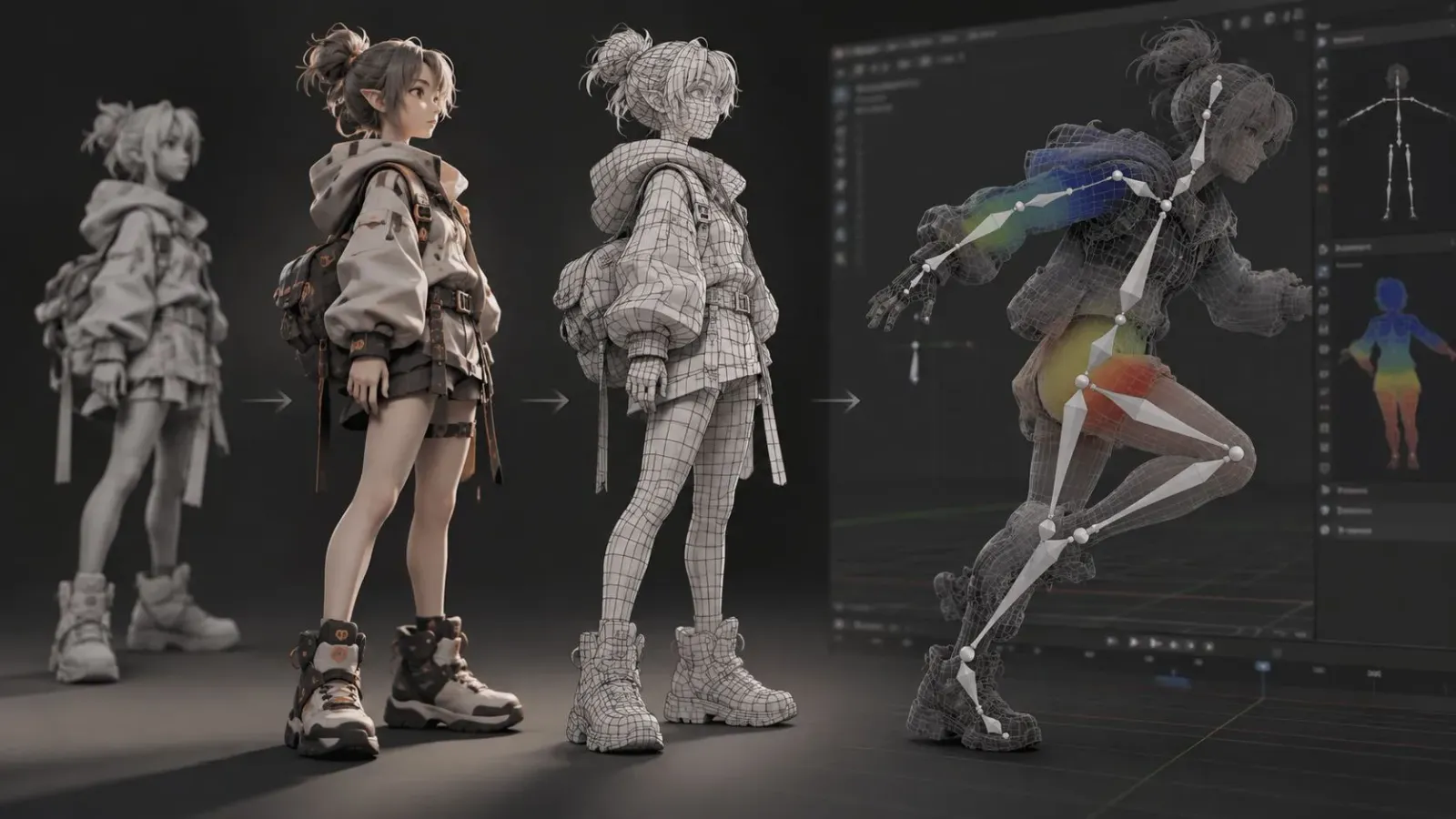
Tripo P2.0: The Story Is Whether the Mesh Survives Blender Rigging
Current Observation / 現況觀察
Around September 13, 2026, Tripo AI highlighted that its P2.0 Smart Mesh (Preview from the August update) can supply structured geometry for OpenAI GPT-6 Astra to operate downstream work in Blender. The demo path uses a configured Blender MCP setup so Astra acts as an in-app operator, not just another text-to-3D button.
According to RuntimeWire and Tripo’s own materials, P2.0 Preview focuses on native quad topology from multi-view references, with generation often in the 10–40 second range and mesh budgets cited up to about 50,000 triangles or 25,000 quads. Semantic part separation (clothing, armor, and similar) is part of the pitch for later texturing and rigging.
The same tutorials refuse a one-click fantasy: after import, creators still inspect neck joins, proportions, materials and silhouette; after rigging they test head turns, arm raises, elbow and knee bends, then fix failed weights. Physics such as hair stays a separate setup.
Background Analysis / 背景分析
For a year, AI 3D has gotten strong at “looks right from a kind angle.” Characters and props for games or real-time pipelines face a harder exam: editable polygons, bendable joints, manageable parts inside Blender.
So P2.0 sells the unglamorous middle — topology, segmentation, export behavior — not another prettier preview. Tripo’s talk of bridges to Blender, Maya, 3ds Max and Unreal, plus faster FBX export, points the same way: make generated meshes handoff assets, not terminal screenshots.
Pairing P2.0 with Astra also fits the two lines already on this site: Astra can drive Blender; agents/MCP make tools callable. Tripo wants the upstream slot — the cleanest editable geometry for whichever agent a creator picks. Meshy, Rodin and others are chasing smart topology and segmentation too. The fight is “time saved after generate.”
Impact Assessment / 影響評估
For indie / game artists: If quads and parts hold up outside demos, you may skip a chunk of retopo — while still treating inspection and weight fixes as normal workflow, not failure.
For open toolchains: The Blender MCP demo keeps open DCC as an agent stage. You can try “Tripo out → Blender in” without buying a closed stack.
For expectation control: Official tutorials list neck joins, deformation tests and separate physics. That honesty is more useful than a flashy reel. The right metric is hours from generate to movable, not preview beauty.
Future Outlook / 未來展望
Watch three things: stability and controls beyond Preview, topology quality on non-showcase cases, and whether a manual Blender path (no Astra) still saves work. If it only shines with an agent babysitting, the value narrows.
Practical test: run one multi-view character through P2.0, rig basic motion in Blender, and log how long cleanup takes. Your notebook beats the trailer.
Personal Perspective / 個人觀點
This news is interesting because the conversation finally moves from “more likeness” to “can it be rigged.” Generation is loud; production cost lives in cleanup and editability. Betting on geometry structure is the right direction — and keeping a human checklist makes the claim more believable.
Conclusion / 結論
Tripo P2.0 with Astra/Blender marks another step in AI 3D competition toward editable, riggable, engine-ready assets. For Halabaojia readers, the question is not another brand name, but whether Smart Mesh really cuts retopo and pre-rig cleanup — and the manual checks Tripo still lists are exactly the right expectation for now.