GPT-6 Astra Demo Drives Blender Into Unreal: AI Starts Touching Production UIs
GPT-6 Astra Demo Drives Blender Into Unreal: AI Starts Touching Production UIs
Current Observation / 現況觀察
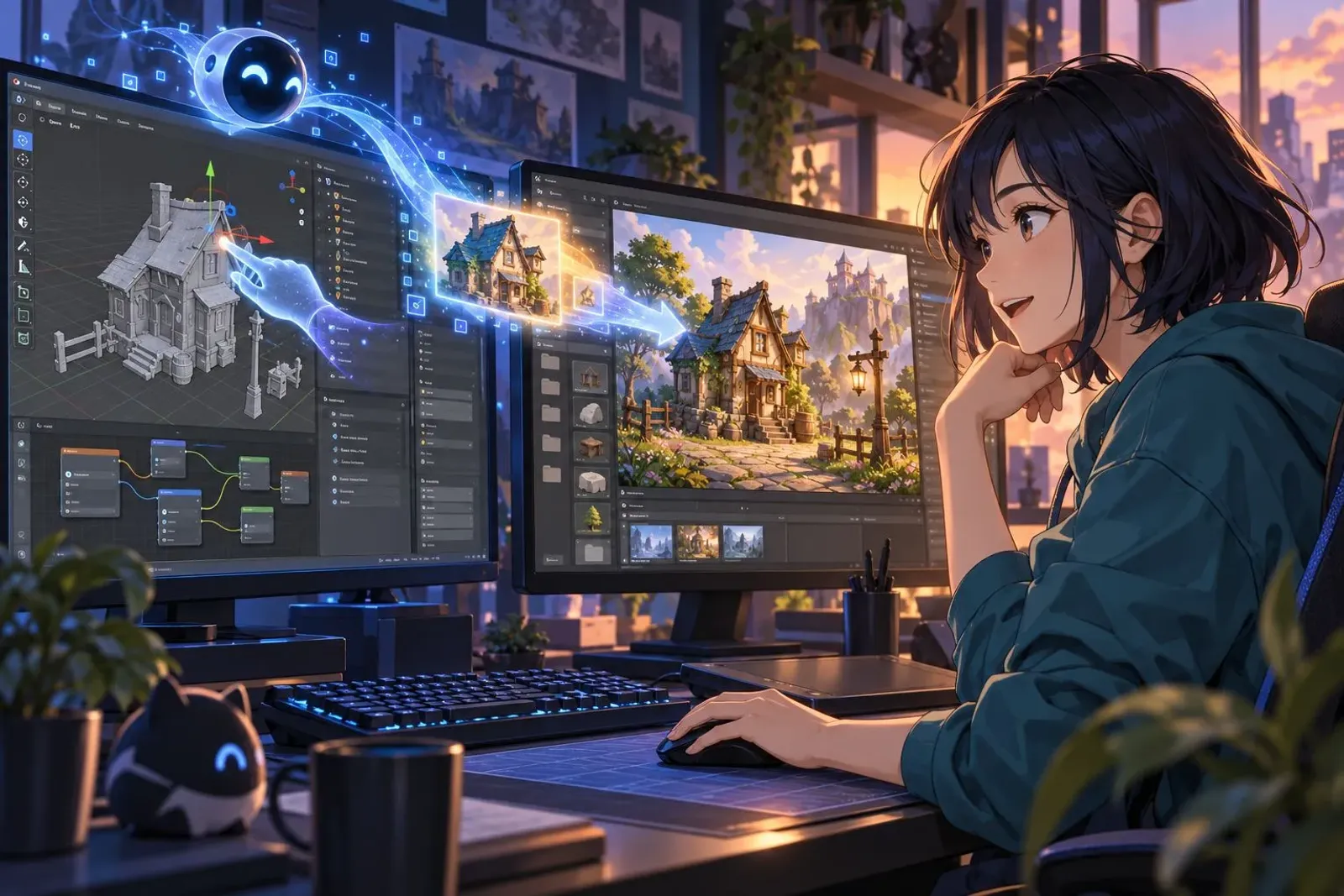
On September 3, 2026, OpenAI announced GPT-6 Astra and began rolling it out to selected organizations, positioning it for computer use and longer multi-step work. One public demo shows the model building a house scene in Blender, then transferring that content into a walkable Unreal Engine 5 environment.
This is worth logging not because “AI made 3D again,” but because the demo emphasizes operating editable production software. Image and mesh generators already exist in volume. Selecting objects in Blender, editing coordinates, respecting hierarchy, adjusting lights and cameras, and continuing without wrecking prior work is much closer to real pipeline motion.
Follow-up coverage such as RuntimeWire also notes 3D artist Stefan Vaskevich reacting with caution: the issue is less whether one demo looks polished, and more “how fast these systems are improving.”
Background Analysis / 背景分析
For the past year or two, most AI×3D talk stayed at “text/image to assets”: spit out models and textures, then humans fix topology and import to engines. Astra-style computer-use demos try the next layer: treat Blender and Unreal themselves as execution environments.
That can coexist with the Blender Foundation’s stance. Official messaging has been clear that Blender does not plan to integrate generative AI features and remains a tool made by humans for humans. External models can still “use” Blender through UI control, scripting, or outside connections. The app can stay human-centered while becoming an agent target.
For indie teams and open-source pipelines, the near-term upside looks like automated blockouts, repetitive scene edits, cross-app transfers, and rough client walkthroughs. The usual blockers remain art direction, performance budgets, asset consistency, rights, and deciding when something is actually finished.
Impact Assessment / 影響評估
For games / real-time content pipelines: If an agent can stably handle basic scene ops, level prototypes and environment previews get faster. A controlled demo still does not prove reliability across unfamiliar add-ons, large files, or studio-specific naming and folder conventions. Public materials also do not provide a standard Blender benchmark or success-rate data.
For creator roles: Repetitive modeling, scene tweaks, and export steps may shrink. Prompting, review, assembly, and finishing become more valuable. That is not the same sentence as “AI replaces artists”; it is a reshuffle of pipeline labor.
For the tool ecosystem: Blender refusing built-in generative AI does not mean agents will ignore it. Open DCC tools may become preferred demo stages precisely because their interfaces and scripting surfaces are open.
Future Outlook / 未來展望
What matters next is not a flashier demo, but whether three gaps get filled: stability on real project files, repeatable evaluation methods, and human review/rollback workflows. If those mature, directing and reviewing machine-operated work becomes core 3D skill faster. If not, Astra’s wave stays at the showcase layer.
For people still on Blender / Godot / open toolchains, the practical stance is simple: use AI to speed prototypes and chores, keep the final quality gate with humans, and keep notes on which steps actually save time versus which collapse on large scenes.
Personal Perspective / 個人觀點
The value of this news is that it pulls the conversation from “what the generated result looks like” back to “who is pressing Blender.” Generation is noisy; production value is editability, handoff, and accountability. Astra shows a possible path, but not yet the judgment and convergence needed for commercial projects.
So treat this as a short news marker: AI is starting to touch DCC UIs. Whether it belongs in your shipping level folders still depends on stability and review systems, not the trailer.
Conclusion / 結論
The GPT-6 Astra Blender → Unreal demo marks another step from “generate assets” toward “operate production software” in AI×3D. For indie and open-source pipelines, it hints at faster prototyping and also warns that a controlled showcase is not a shippable asset. Longer pipeline notes should wait for verifiable success rates and real project cases.