MECCHA CHAMELEON Cheat Problem: What Does an Auto-Paint Tool Break When Visual Creativity Is the Game?
MECCHA CHAMELEON Cheat Problem: What Does an Auto-Paint Tool Break When Visual Creativity Is the Game?
Current Observation / 現象觀察
After MECCHA CHAMELEON went viral in June 2026, it soon ran into a subtle problem: players started using auto-paint cheats. PC Gamer reported on July 6, 2026, that some players were using software to scan scene imagery and automatically paint a background-like pattern onto their characters, making it easier to evade the seeker than ordinary players.
This is worth writing about not simply because “a popular game has cheaters,” which is common, but because the core pleasure of MECCHA CHAMELEON is built around hands-on camouflage. The Steam page describes the premise directly: players paint their white bodies with scene colors, then rely on hiding spots, poses and artistic judgment to fool the seeker’s eyes. In other words, the game is not purely about reaction speed; it mixes visual observation with clumsy creativity.
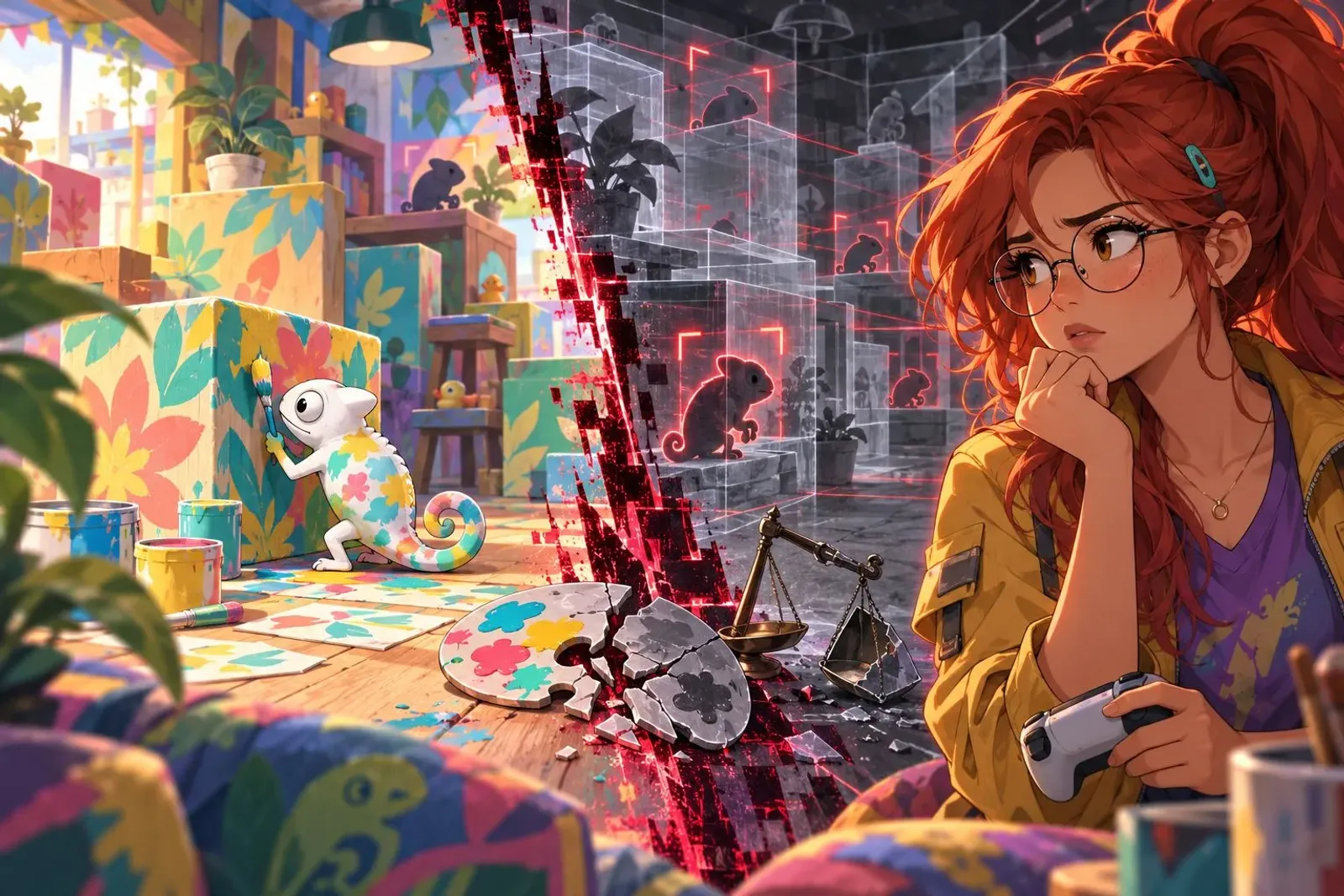
When an auto-paint cheat automates the three steps of “observe, judge and paint,” it damages more than fairness. It removes the central interaction players were meant to perform themselves.

Background Analysis / 背景分析
A large part of MECCHA CHAMELEON’s success comes from turning hide-and-seek into a form of visual creation. Traditional Prop Hunt games usually have players become scene objects, with the focus on choosing a position and acting the part. This game instead asks players to paint their own character until it resembles the background. When it works, you feel clever; when it fails, the character looks like an unnatural blob of paint, which becomes part of the joke everyone shares.
That design depends heavily on imperfection. A wrong color, an unfinished edge, a mismatch in light and shadow, or a bad position are all visible flaws. The seeker’s fun also comes from spotting those flaws: what looks slightly wrong in the image? Which patch of wall has an odd color? Which corner contains an unreasonable extra outline?
An auto-paint cheat skips precisely this most interesting, awkward process. It does not make the player shoot more accurately or move faster; it completes the visual judgment for them. In this game, that is more damaging than ordinary stat-based cheating because it steals the performance the player was supposed to create by hand.
Impact Assessment / 影響評估
The first impact is fairness. Ordinary players must observe the environment under pressure, choose colors and manage their outlines, while cheaters can use software to transfer background information directly onto their character. That takes away the seeker’s reasonable space for judgment and distorts the skill gap between hiders.
The second impact is readability. A good party game should not only be playable; spectators should be able to understand it too. The original humor of MECCHA CHAMELEON comes from immediately seeing that someone painted badly, hid in a risky spot, or was almost discovered. If a cheat makes camouflage too accurate, the image loses the mistakes that viewers can read and enjoy.
The third impact is community trust. The game relies heavily on public rooms, friend lobbies, streaming interactions and audience participation. Once players start wondering whether someone is matching the background with a tool instead of observation and feel, the whole atmosphere becomes more defensive. When a party game loses its relaxed mood, it can quickly shift from “everyone failing together” to “everyone watching for cheaters.”
Design Core / 設計核心
The most important point here is that winning and losing are not actually the core of MECCHA CHAMELEON. What it sells is low-barrier visual creativity. Players laugh because someone tried hard but still painted an unnatural disguise; seekers get excited because they spotted a flaw in a chaotic image; spectators want to share the moment because the failure is immediate and easy to understand.
That is why a cheat damages more than the result of a single round. It breaks the design structure in which “failure is still fun.” When players do not have to make mistakes, guess colors or accept the roughness of hand-painted camouflage, the game loses much of its personality-driven humor.
This is also why some cheats feel more obvious in party games than in competitive games. Cheats in competitive games usually damage rankings, win rates and match fairness. Cheats in party games damage the atmosphere. In the first case, the rules are broken; in the second, the reason everyone wanted to keep playing is weakened.

Developer Challenge / 開發者挑戰
For a small indie team, this kind of problem is difficult. MECCHA CHAMELEON is an inexpensive, lightweight game that spreads through its community, so it could not realistically have a large competitive game’s anti-cheat system from day one. But when sales and concurrent players suddenly surge, cheaters, malicious players and tool makers arrive as well.
A practical response may be layered management rather than relying only on strict blocking. Friend and private rooms can preserve a relaxed play style, while public rooms need basic tools such as reports, kicks, host permissions and suspicious-behavior detection. Streamers also need easier ways to manage audience matches so that one cheater cannot ruin an entire piece of content.
Another direction is to make “evidence of hand painting” part of the rules. For example, the game could limit texture changes that happen too frequently, check whether painting exceeds a normal brush speed, or give seekers clues that reveal camouflage that is too perfect. The goal is not to make the system absolutely secure, but to make the cost of cheating higher than the benefit of ruining the fun.
Future Outlook / 未來展望
The cheating problem in MECCHA CHAMELEON reflects a shared risk for social novelty games that go viral. The simpler, clearer and more short-video-friendly a game is, the more likely it is to attract a large number of non-core players in a short time. That is both an advantage and a source of pressure.
When a game succeeds because “friends can play it together,” it has to protect the state of making mistakes together, laughing together and spotting flaws together. Otherwise, the more popular the game becomes, the more chaotic public rooms may feel. The people left behind may not be those who love the game’s premise most, but those who are best at exploiting its gaps.
For creators, this is a useful reminder: if your game’s core is a player’s handmade performance, acting, creativity or social interaction, anti-cheat is not merely a technical concern. It is a design-protection concern. What you are protecting is not the leaderboard, but the space where players feel comfortable embarrassing themselves together.
Personal Perspective / 個人觀點
I think the most valuable thing about MECCHA CHAMELEON is that it turns imperfection into content. Painting inaccurately, hiding awkwardly and being discovered in an embarrassing way are not side effects of failure; they are part of why the game went viral.
That is also what makes the auto-paint cheat so harmful. It turns players from creators into people who merely output a result. A disguise that once had feel, flaws and humor becomes an automated background-matching optimization. The game may look more competent, but it becomes more boring.
Conclusion / 結論
The MECCHA CHAMELEON cheating incident reminds us that fairness in a party game comes not only from numerical balance, but also from a shared understanding that having fun matters more than winning. When a cheat automates visual creativity, the game loses more than a fair result: it loses the process of players messing up, succeeding and being found out with their own hands.
That is why this case is worth watching. Going viral can bring players, sales and community content, but it also amplifies the pressure of governance. Whether MECCHA CHAMELEON can preserve its relaxed party-game atmosphere will matter more than simply adding more content.
Related Resources / 相關資源:
-
PC Gamer: Cheaters have infested Meccha Chameleon as dishonest players scan images and auto paint their models
- A July 6, 2026 report on the auto-paint cheating phenomenon and community response
-
MECCHA CHAMELEON on Steam
- Official gameplay description, release information and player reviews
-
PC Gamer: Meccha Chameleon celebrates 15 million sales
- Additional context on the game’s sales and follow-up collaboration after it went viral
Tags / 標籤: #MECCHA_CHAMELEON #game_design #indie_games #cheating #party_games #visual_design