Godot 4.7 Update: HDR, Asset Store, and Android Workflow
Godot 4.7 Update: HDR, Asset Store, and Android Workflow
Current Observation
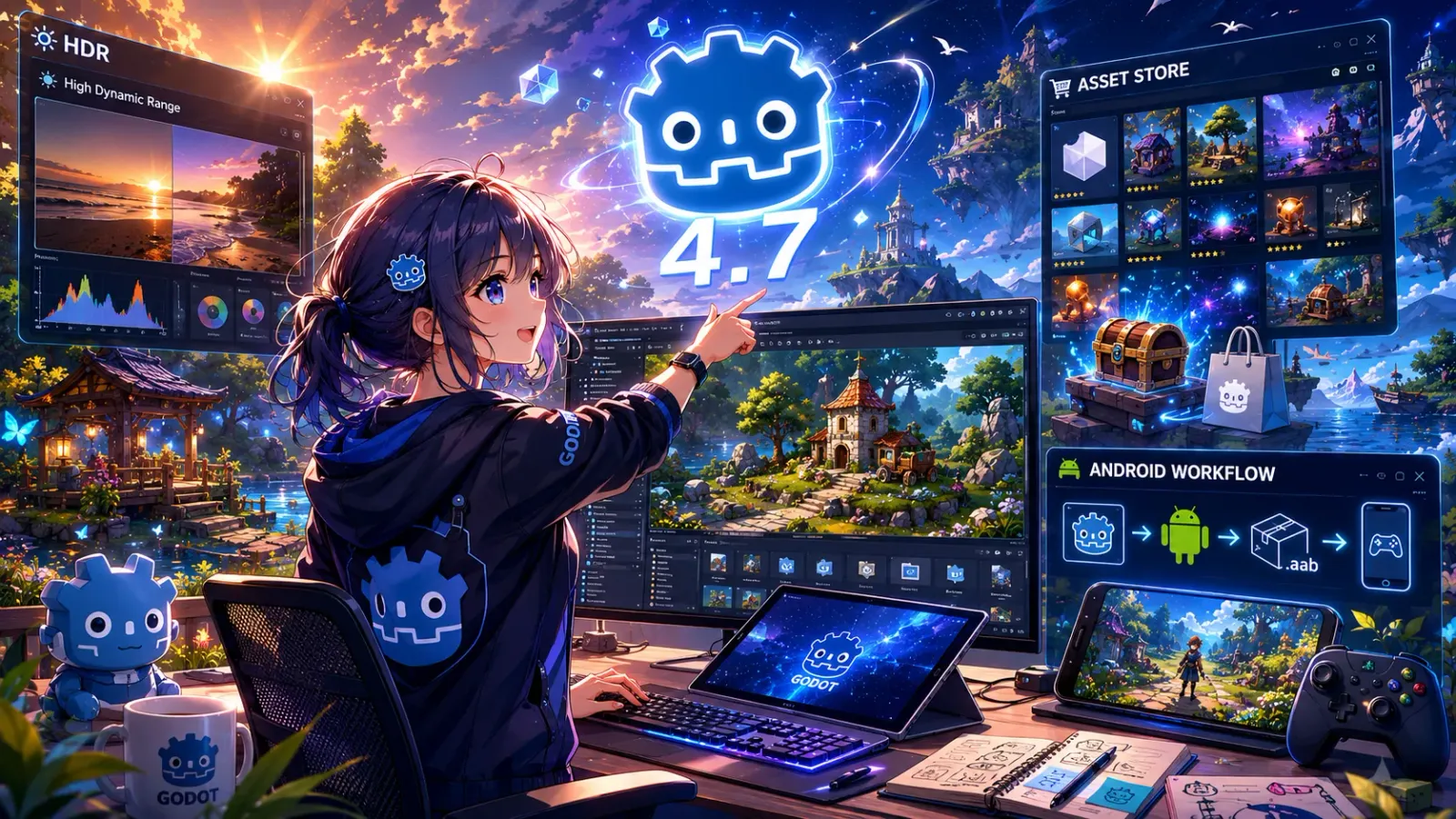
Godot officially released Godot 4.7 on June 18, 2026. This update is not built around one headline feature. Instead, it pushes the Godot 4.x line closer to a more complete production environment. As of June 22, the most discussed areas in the community are clear: visual output, asset discovery, Android production workflows, and everyday editor efficiency.
The official release theme, “Lights, Camera, Action!”, fits the update well. Godot 4.7 introduces HDR output, allowing 2D and 3D projects to display a wider range of brightness and color on supported platforms. It also adds AreaLight3D, giving creators a more direct way to create rectangular light sources such as signs, screens, window light, and soft interior lighting without relying only on emissive materials or global illumination workarounds.
For creators, the signal is important. Godot is no longer only answering whether something can be done. It is increasingly focused on whether the workflow feels practical, predictable, and close enough to a real production pipeline.

Background Analysis
Godot 4.0 established the foundation for the Vulkan generation in 2023. Since then, several releases have focused on stability, editor improvements, and workflow details. With 4.7, Godot’s direction is becoming clearer. It is not simply trying to chase the visual checklist of large commercial engines. Instead, it is filling practical gaps around open source development, cross-platform delivery, and accessible production.
HDR output is one of the clearest examples. Godot has long handled lighting internally with HDR data, but when output was limited to SDR displays, many highlights and color details were compressed before reaching the screen. Godot 4.7 adds HDR output support for Windows, macOS, iOS, visionOS, and Linux Wayland, giving bright effects, neon scenes, magic abilities, and sci-fi UI more room to breathe.

Another key change is the new Asset Store. The old Asset Library helped Godot during its earlier growth, but as the ecosystem expanded, a simple resource list was no longer enough. Godot 4.7 works with the new Asset Store to improve asset display, preview image scaling, rating information, and background threading. Searching for plugins, examples, and reusable project resources now feels closer to what modern developers expect.
Impact Assessment
For 3D artists and technical artists, AreaLight3D and HDR output are the most direct changes. Rectangular lights make it easier to handle windows, lightboxes, screens, storefront signs, and soft indoor lighting. These effects were possible before, but they often required more material setup, GI tuning, or post-processing. Turning them into a direct node option lowers the cost of lighting iteration.
For 2D game developers, the new offset transform properties for Control nodes are especially useful. UI animation inside containers has often been awkward because rotation, scaling, or movement could be overwritten by layout behavior. The new offset transform works more like a CSS transform concept. It helps create button feedback, menu transitions, and sliding panels without breaking the original container layout.
Android workflow is another major focus. Godot Android Build Environment, or GABE, allows the Godot editor running on Android and XR devices to handle more Gradle export and publishing steps. Godot 4.7 also improves the embedded game window in the Android editor, screen orientation handling, native splash screen options, Perfetto tracing, and the ability to implement Java interfaces from GDScript. This means making and publishing a Godot game directly from an Android device is moving beyond a showcase feature and toward a practical workflow.
Future Outlook
The broader signal from Godot 4.7 is that Godot is expanding its delivery boundary. Many teams already value Godot because it is free, open source, lightweight, and strong for 2D development. But a more complete commercial workflow also needs asset ecosystem support, cross-platform export, performance analysis, UI tools, 3D editor details, and stronger visual output.
Godot 4.7 does not need to claim that it fully replaces Unity or Unreal Engine. That is not the most useful framing. The better read is that Godot is closing practical gaps one by one. As the Asset Store matures, Android production becomes more complete, and HDR plus 3D lighting tools become more stable, the adoption risk for small teams continues to drop.
The next thing to watch is how these features behave in real projects. HDR depends on display, operating system, and platform support. Android production workflows still depend on device performance, input methods, and plugin compatibility. The Asset Store will need strong search, review, rating, and maintenance quality as the community continues to grow.
Practical Application
If a project is currently on Godot 4.6 or an earlier version, upgrading the main branch immediately is not the best move. A more practical approach is to clone a test branch and evaluate the update in three focused areas.
First, check visual output. If the project uses neon scenes, strong highlights, magic effects, sci-fi UI, or high-contrast environments, test whether HDR output and AreaLight3D make lighting setup more direct.
Second, check UI animation. If menus rely on Control and Container nodes, rebuild one or two transitions with offset transform properties. The goal is to see whether the new workflow reduces wrapper nodes, manual layout fixes, or fragile animation setups.
Third, check the publishing flow. If Android is a target platform, test GABE, Android export options, Perfetto tracing, and splash screen settings. These features may not change the game itself, but they can directly improve the final checks before release.
Personal Perspective
The most important part of Godot 4.7 is not any single feature. It is the density of workflow details. This shows that the Godot team is not only filling large feature gaps. It is also addressing the small frictions creators run into every day.
For independent developers, that matters. Godot’s strength has never been about producing the most expensive showcase. Its strength is giving small teams control. As export, assets, UI, lighting, and mobile workflows mature, Godot becomes a more credible long-term option for real projects.
Conclusion
Godot 4.7 is a steady production-focused update. HDR output and AreaLight3D improve visual presentation, the new Asset Store improves asset discovery, and Android plus XR workflow improvements make mobile development more complete.
If you are building 2D games, lightweight 3D scenes, mobile prototypes, or open source tools, Godot 4.7 is worth testing in a separate branch. The goal is not to rush the upgrade. The goal is to verify whether these tools reduce real production rework.
Related Resources:
-
Godot 4.7 official release page
- Full update highlights and download links
-
HDR output arrives in Godot 4.7
- Official technical note for HDR output
-
Godot Mobile update April 2026
- Android and XR editor progress
-
Godot 4.7 Migration Guide
- Compatibility notes to review before upgrading
Tags: #Godot #Godot4_7 #GameEngine #OpenSource #GameDevelopment #TechNews