OpenUSD and Generative AI: 3D Art Pipelines Enter a Standardized Era
OpenUSD and Generative AI: 3D Art Pipelines Enter a Standardized Era
Current Observation
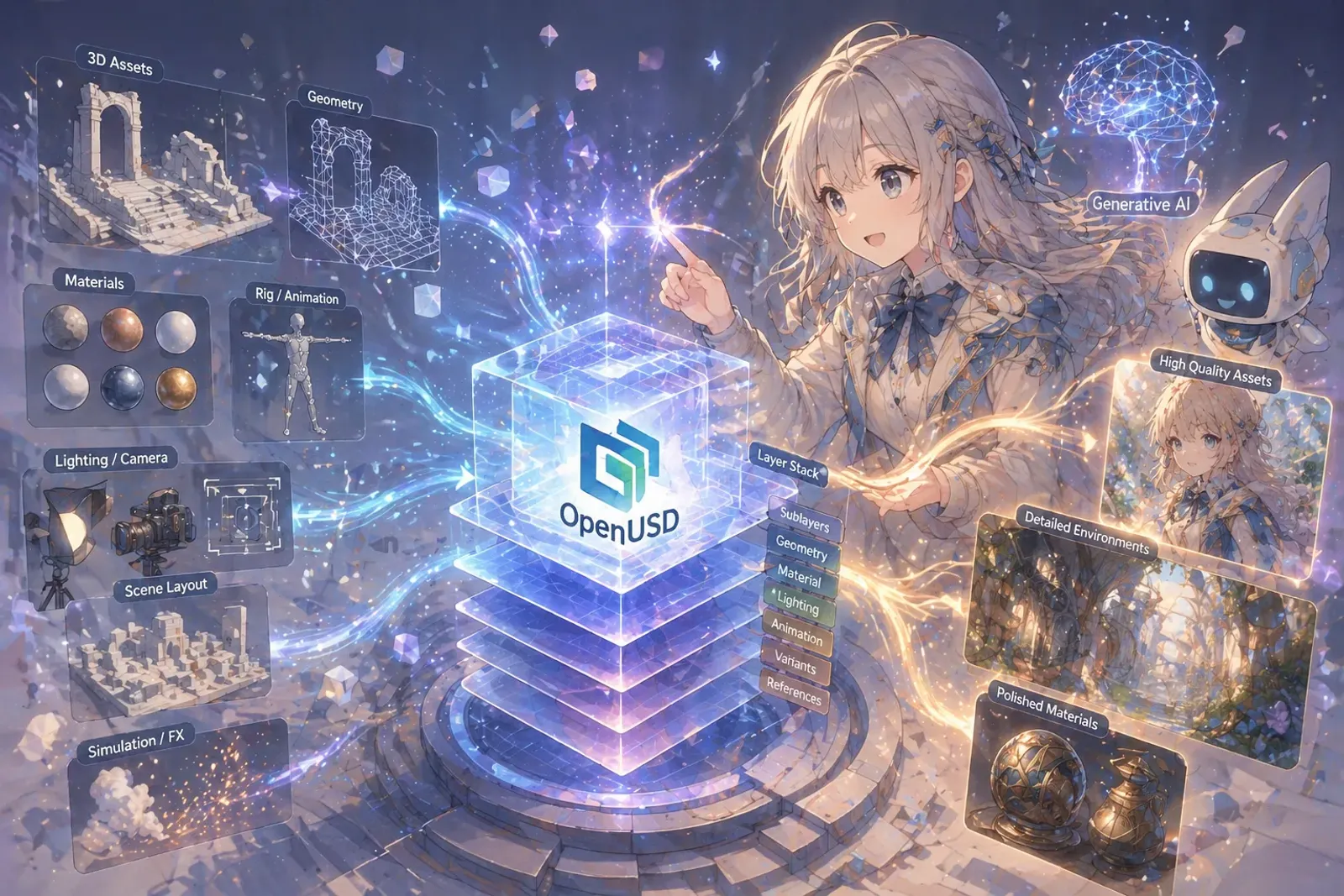
One of the most important 3D and art-AI news signals in early 2026 is not a single model launch. It is the acceleration of workflow standardization. OpenUSD (Universal Scene Description) is increasingly becoming the structural layer that connects DCC tools, real-time engines, and generative AI systems in one production pipeline.
For years, artists have dealt with the same friction: modeling in one tool, lookdev in another, animation in a third, then manually forcing AI-generated outputs to match composition and continuity. The process worked, but it was expensive in time and difficult to scale.
The current shift is different. Teams are now using OpenUSD to organize scene structure, asset relationships, and versioning, while AI handles controlled variations such as style exploration, texture ideation, and background extensions.
This matters because it moves creative production toward three qualities that businesses actually need: traceability, repeatability, and reliable delivery.
Background Analysis
Why is this trend gaining momentum in 2026? Three reasons stand out.
First, major tools are converging on shared scene logic. OpenUSD adoption has expanded across VFX, animation, design, and interactive content ecosystems. As scene data becomes easier to pass between tools, AI outputs can become managed production assets instead of isolated images.
Second, commercial teams need consistency at scale. Brands, game studios, and e-commerce teams now produce assets for many channels at once, each with strict visual requirements. Prompt-only generation can be fast, but cross-batch consistency is still difficult. OpenUSD plus AI helps solve this governance gap.
Third, creator roles are evolving. The market now values pipeline design, not only prompt skill. Teams that can combine scene standards, naming conventions, AI node strategies, and review checkpoints gain a clear operational advantage.
Impact Assessment
The impact is practical across multiple creator groups.
For game art teams, OpenUSD improves synchronization across level design, props, characters, and lighting contexts, while AI accelerates concept variations and material exploration. This usually means faster pre-production and less downstream rework.
For brand and commercial visual teams, the biggest gain is version control. If one campaign scene needs ten output ratios, three seasonal looks, and multiple market variants, a USD-based scene foundation with AI-driven variants is far more stable than manual duplication.
For solo creators and small studios, this trend unlocks scalable craft. Reusable camera setups, lighting blocks, material node presets, and AI prompt modules reduce repetitive setup work and increase output consistency.
But risks remain clear.
If teams standardize speed without legal governance, licensing issues can scale just as quickly as production. If they optimize only for throughput, visual sameness will rise. Better systems improve productivity, but they do not replace art direction or responsibility.
Future Outlook
Over the next year, we are likely to see three directional shifts.
First, from model-centric thinking to scene-centric thinking. Teams will care more about scene semantics, asset relationships, and camera continuity than one-off image quality.
Second, from individual techniques to team standards. Organizations will formalize naming rules, reusable node templates, review protocols, and AI safety policies that keep outputs aligned across contributors.
Third, from static outputs to multimodal assets. A single USD scene base will increasingly drive still images, short video variants, interactive previews, and commerce-ready visual packs.
Practical Application
If you want to adopt this approach now, start with a lightweight implementation path:
- Build a small OpenUSD scene template with subject, background layers, lights, and camera presets.
- Define AI node purposes clearly: concept variation, material draft, or environment extension.
- Create version naming rules, such as scene_v01, style_v02, campaign_en_v01.
- Add human review checkpoints for composition consistency, brand safety, and usage rights.
- Package the flow into a reusable kit your team can execute repeatedly.
The goal is not to build a perfect pipeline on day one. The goal is to build a pipeline that can run reliably at least three times with consistent quality.
Personal Perspective
The most meaningful part of this industry update is that it shifts 3D and AI from patchwork integration to systems integration. AI is no longer just an add-on accelerator. It is becoming a controllable module inside a broader production architecture.
For creator communities, this is an opportunity to focus less on chasing every new model and more on building durable workflow logic. If pipeline design is strong, tool replacement becomes easier, output quality becomes more stable, and long-term creative sustainability improves.
Conclusion
The key 2026 signal in 3D and art AI is clear: OpenUSD and generative AI integration is moving creation from one-off output to sustainable production.
This is not only a technical upgrade. It is a structural shift in how creative teams collaborate and deliver. When we manage assets through scene standards and manage AI through workflow rules, quality, consistency, and delivery speed can improve together.
If you run a design team, a game art pipeline, or a creator brand, this is a strong moment to invest. Start with one small scene and one repeatable process, then scale with confidence.
Related Resources:
-
OpenUSD Official Documentation
- Core concepts and practical scene description references
-
Alliance for OpenUSD (AOUSD)
- Ecosystem updates and standardization progress
-
NVIDIA USD Developer Resources
- Technical direction for USD integration in content pipelines
-
Blender Official Site
- Common entry point for scene template creation and asset prep
Tags: #OpenUSD #3DArt #GenerativeAI #Workflow #Interoperability #IndustryInsights