NVIDIA 3D-Guided AI Art: A New Blender Workflow
NVIDIA 3D-Guided AI Art: A New Blender Workflow
Current Observation
The biggest shift in AI image creation is no longer model size alone. It is controllability. For the past two years, text-to-image systems have become faster and more impressive, yet many production teams still face the same practical pain points: unstable composition, camera inconsistency, and weak continuity across a series of assets.
A single image can look brilliant, but when we need ten images for one campaign, one character turntable, or one visual story arc, quality often drifts. Prompt engineering helps, but prompt-only workflows still struggle to guarantee spatial logic and visual consistency at scale.
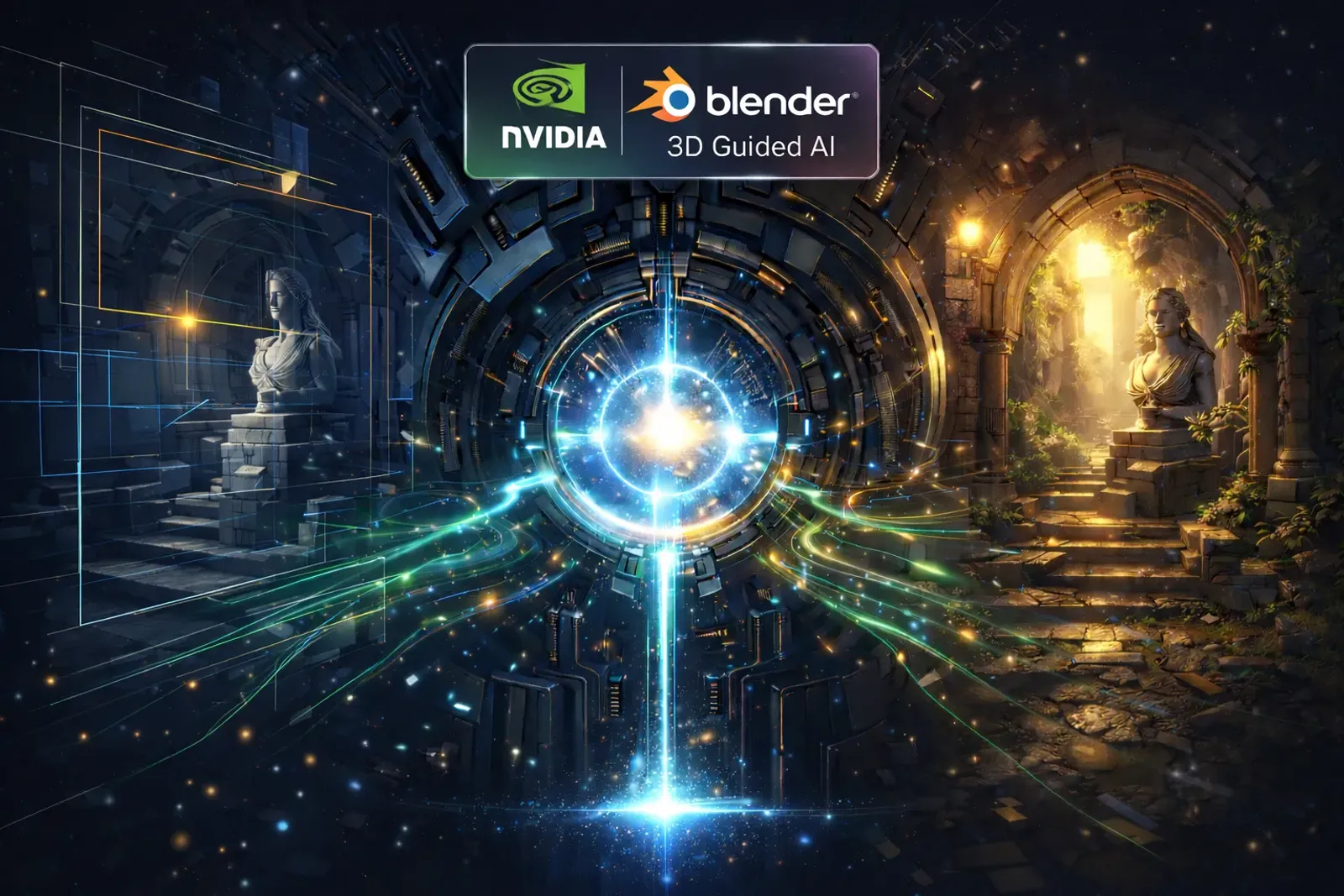
NVIDIA’s early-2025 push around 3D-guided generative workflows addresses this exact production gap. The idea is straightforward but powerful: block composition and camera logic in a 3D environment such as Blender, then use an image model (for example, FLUX-based pipelines) to generate the final stylized output. In this setup, 3D handles structure and perspective, while generative models handle texture, mood, and detail.
While this is not a brand-new April 2026 announcement, it remains one of the most representative industry examples of a controllable AI image pipeline.
This matters because it repositions AI from a “creative lottery” into a controllable visual pipeline. For creators, agencies, and game teams, that is a strategic shift rather than a minor feature update.
Background Analysis
Why is this direction gaining traction now? There are three core drivers.
First, commercial creative demand has changed. Teams now need high-volume content with strict consistency: matching product angles, preserving character proportions, protecting brand visual language, and leaving intentional text-safe areas for layout. Prompt-only generation is fast but can be unpredictable. Full 3D pipelines are precise but often too expensive and time-heavy for rapid content cycles. A hybrid 3D-guided AI workflow closes that gap.
Second, infrastructure is finally practical. Hardware acceleration, inference optimization, and improved local workflows are reducing friction. Techniques such as lower-precision execution and optimized runtime stacks allow more creators to run advanced models on accessible hardware tiers. This pushes 3D-guided generation from isolated demos toward everyday production.
Third, the creator role is evolving. The market no longer rewards only “good prompts.” It rewards creative direction systems: camera planning, spatial composition, visual hierarchy, model routing, and controlled iteration. In other words, we are moving from prompt authorship to pipeline authorship.
That transition is especially important for teams that need repeatable quality. Repeatability is where creative businesses survive.
Impact Assessment
The impact is already visible across different creator segments.
For game and interactive teams, 3D-guided generation enables faster concept packages with stronger world coherence. Teams can block level viewpoints and prop placement in low-poly scenes, then generate multiple key art candidates while preserving spatial logic. This reduces rework between concept, narrative, and environment art.
For brand and marketing teams, the workflow helps control campaign consistency. Product placement, camera height, horizon lines, and visual focus can be locked before generation. This reduces common revision loops such as “the product angle changed,” “the logo area is blocked,” or “the character style drifted from the campaign guide.”
For solo creators and small studios, the biggest win is reusable templates. Once a base 3D scene and style recipe are defined, creators can produce seasonal variants, regional editions, and channel-specific outputs faster without rebuilding from scratch.
Still, there are real risks.
Speed can lead to visual sameness if teams optimize only for throughput. Also, legal and licensing discipline remains essential: model usage rights, training data concerns, and commercial deployment boundaries must be reviewed before launch. Better tooling does not remove responsibility.
Future Outlook
Over the next 12 months, this trend will likely move in three directions.
First, from single-image generation to narrative continuity. 3D-guided foundations naturally support character consistency, scene progression, and world-level storytelling. We will see more pipelines designed for sequences, not isolated hero shots.
Second, from individual tricks to team standards. Organizations will increasingly formalize shared scene templates, camera presets, style controls, safety checks, and export conventions. The value will come from collaborative consistency rather than one expert’s private prompt library.
Third, from still images to multimodal asset systems. Once a scene is structured in 3D, it can feed image generation, short-form video variants, interactive previews, and e-commerce visuals with less duplication. The central unit becomes a reusable scene asset, not a one-off output.
This is where hybrid creative operations become powerful: one intent, many deliverables, controlled quality.
Practical Application
If we want to adopt this workflow today without overcomplicating the process, we can start with a lightweight six-step framework:
-
Create a 15-30 minute blockout in Blender. Keep only essential geometry, one main light direction, and planned camera angles. Do not over-detail.
-
Export structural guidance passes. Depth, normal, or line guidance can help preserve perspective and composition during generation.
-
Define a stable generation recipe. Use consistent seeds, concise style constraints, and a fixed output aspect strategy before exploring variation.
-
Batch-generate candidate outputs. Generate 6-12 options per camera setup, then shortlist based on readability and message clarity, not novelty alone.
-
Apply targeted refinements. Use inpainting or local edits for high-priority areas: faces, products, typography zones, and interaction focal points.
-
Package as a reusable template. Save scene files, prompt modules, model settings, and post-processing presets as one repeatable production kit.
The key is operational consistency. A workflow only creates business value when it can be repeated by more than one person on the team.
Personal Perspective
My view is simple: the long-term winners in AI art will not be the teams with the longest prompts, but the teams with the clearest creative systems.
NVIDIA’s 2025 3D-guided direction is important because it gives creators a better way to preserve intent. Composition is intent. Camera is intent. Spatial hierarchy is intent. If those elements are unstable, visual quality alone cannot save the message.
For creators who care about meaningful impact, this shift is encouraging. It allows us to produce faster without abandoning craft. It allows small teams to scale output without sacrificing identity. Most importantly, it allows creative work to become more reliable for the people who depend on it: learners, players, customers, and communities.
In that sense, 3D-guided AI is not only a technical upgrade. It is a workflow philosophy that respects both creativity and responsibility.
Conclusion
NVIDIA’s 3D-guided AI image workflow signals a broader transition in visual production: from prompt-first experimentation to structure-first creation. By separating composition control from style generation, teams can reduce instability, improve consistency, and build scalable content systems.
For anyone producing recurring visual content, this is a practical moment to adopt the method. Start small: one scene, one camera setup, one clear communication goal. Build one repeatable pipeline, validate quality, then scale.
The core value is not just speed. It is dependable creative delivery. When we can repeatedly turn intent into high-quality outputs, AI stops being a novelty and becomes real creative infrastructure.
Related Resources:
-
NVIDIA: GeForce RTX 50 Series for Generative AI Creators (Jan 2025)
- Official overview of performance and creator workflow direction
-
Blender Official Site
- Core tool for scene blocking and camera planning
-
ComfyUI
- Node-based pipeline builder for repeatable image workflows
-
FLUX.1 [dev]
- Reference model page often used in high-fidelity generation workflows
Tags: #NVIDIA #Blender #AIArt #FLUX #3DWorkflow #IndustryInsights