Open-Source 3D Toolchain Rising: Blender + Krita + Godot Become the New Indie Game Art Standard
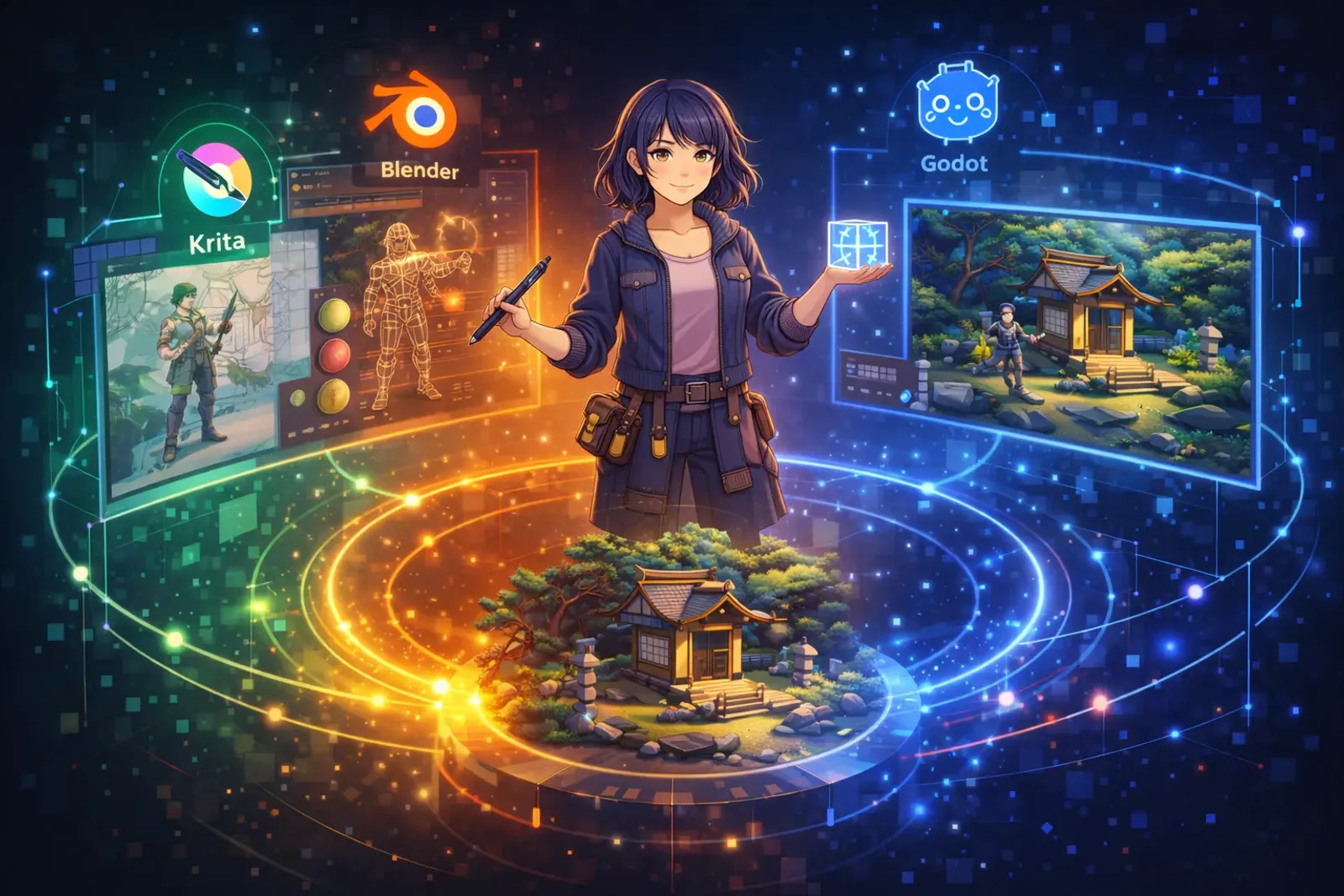
Open-Source 3D Toolchain Rising: Blender + Krita + Godot Become the New Indie Game Art Standard
Current Observation
In Q1 2026, more indie teams are moving Blender, Krita, and Godot from a “budget backup” into their default production stack. This shift matters because it is not about one tool suddenly going viral. It is about three tools forming a practical loop for modeling, texturing, integration, and iteration.
For small studios, the real win is not only lower licensing cost. It is higher workflow predictability. When artists, technical artists, and programmers work within one stable toolchain, rework drops and version cadence becomes easier to maintain.
Background Analysis
There are three main reasons behind this momentum.
First, teams are prioritizing risk control. In recent years, frequent pricing and licensing changes in commercial tools pushed many studios to reassess long-term cost and control. Open-source tools offer transparency, continuity, and customization, reducing the chance that a single vendor decision will force a full pipeline reset.
Second, tool maturity has crossed a practical threshold. Blender keeps improving consistency in modeling, node workflows, animation, and output. Krita is more stable in brush feel, layer management, and texture painting tasks. Godot is steadily filling gaps in 2D/3D hybrid workflows, deployment, and development efficiency. Each tool is strong on its own, but together they now support reliable delivery.
Third, community resources are denser than before. Tutorials, add-ons, templates, open projects, and multilingual learning materials are much easier to find. New teams can build on proven workflows instead of spending months solving the same setup problems from scratch.
Impact Assessment
For indie teams, the most direct impact is shifting cost and energy away from licensing and tool switching, and back into content quality and testing iteration. This affects more than budget planning. It influences whether a project can grow on schedule.
- Healthier cost structure: savings are not just software fees, but also fewer migration costs from tool lock-in.
- Better collaboration consistency: naming, export, and versioning standards are easier to align.
- Faster experimentation: concept-to-playable time is shorter, enabling earlier market validation.
- More sustainable talent growth: new members can onboard faster through public resources and shared practices.
This toolchain also expands access. More schools, communities, and independent creators can participate in production. Lower entry barriers allow the industry to include people from more diverse backgrounds, which strengthens the ecosystem over time.
Future Outlook
Over the next year, the key question will shift from “Can we build with this stack?” to “Can we produce at scale with stable quality?” We expect three clear trends:
- AI assistance will be integrated deeper into production, while final quality control remains human-led.
- Teams will put more focus on shared standards, including naming rules, material templates, and export checklists.
- Community-built bridge tools will grow, improving data flow between DCC tools and game engines.
In short, long-term competitiveness is not about choosing a trendy tool. It is about building repeatable, handover-friendly, and sustainable methods with the tools you already use.
Practical Application
If your team plans to adopt Blender + Krita + Godot, use a small-step rollout instead of a full switch all at once.
- Pick one small scene as a vertical slice and define the complete path from modeling to engine integration.
- Set minimum shared standards for naming, texture resolution, material naming, and export settings.
- Run a weekly rework review and fix the two most frequent blockers first.
- Document reusable workflow steps so new members can ship their first usable asset within two days.
This approach helps teams convert the open-source stack into organizational capability without disrupting active production.
Personal Perspective
From a creator’s point of view, the value of an open-source toolchain is never just that it is free. It changes the relationship between creators and tools. Instead of adapting to external licensing cycles, teams can shape workflows around real project needs and accumulate their own production methodology.
More importantly, this level of control opens doors. Students, small teams, and career-switching creators can start building without heavy upfront costs. That makes the game art field more dynamic and makes knowledge sharing more practical across communities. For creators, this is not a short-term trend. It is long-term infrastructure.
Conclusion
Blender + Krita + Godot becoming a new indie game art standard in 2026 is not about one feature beating another. The real advantage is the combination: lower risk, higher flexibility, and sustainable production potential. For teams that want to deliver consistently, the most important move now is not chasing headlines. It is turning this open pipeline into a repeatable delivery system.
Related Resources:
-
Blender Official Website
- Updates on 3D modeling and animation tools
-
Krita Official Website
- Resources for digital painting and texture workflows
-
Godot Official Website
- Documentation and community entry for the open-source game engine
Tags: #Blender #Krita #Godot #OpenSource #GameArt #IndustryInsights