Wizard of Legend Visual Design Analysis: Perfect Fusion of Pixel Art and Fluid Action
Wizard of Legend Visual Design Analysis: Perfect Fusion of Pixel Art and Fluid Action
Game Overview
Wizard of Legend is a Roguelike action game series developed by Contingent99. The original launched in 2018, beloved by players for its fluid combat system and spectacular magic effects. The 2023 sequel, Wizard of Legend 2, significantly enhanced visual presentation and gameplay depth while maintaining the core experience.
The series’ greatest strength is perfectly combining fast-paced action combat with Roguelike mechanics, with visual design being the key pillar supporting this experience. From refined pixel art to fluid skill effects, every visual element serves the core gameplay.

Visual Design Features
Pixel Art Choice and Evolution
Original’s Style Positioning
The original Wizard of Legend adopted a relatively traditional pixel style but demonstrated unique refinement in detail handling. Character designs are simple yet distinctive, using larger pixel blocks to build silhouettes, allowing players to clearly identify their position during rapid movement and skill casting.
Scene design uses a top-down perspective, a choice that allows the game to simultaneously display multiple enemies and skill effects without causing visual chaos. Map coloring primarily uses dark tones, paired with bright magic effects, creating strong contrast.
Sequel’s Visual Upgrade
Wizard of Legend 2 performed comprehensive visual upgrades while maintaining the pixel style:
- Higher Resolution: Increased pixel density for characters and scenes, richer details
- Dynamic Lighting: Added real-time light and shadow effects, magic attacks illuminate surroundings
- Enhanced Particle System: More spectacular skill effects without affecting gameplay readability
- Increased Background Layers: Multi-layer parallax scrolling adds depth to scenes
Color Usage and Visual Hierarchy
Elemental Attribute Color Language
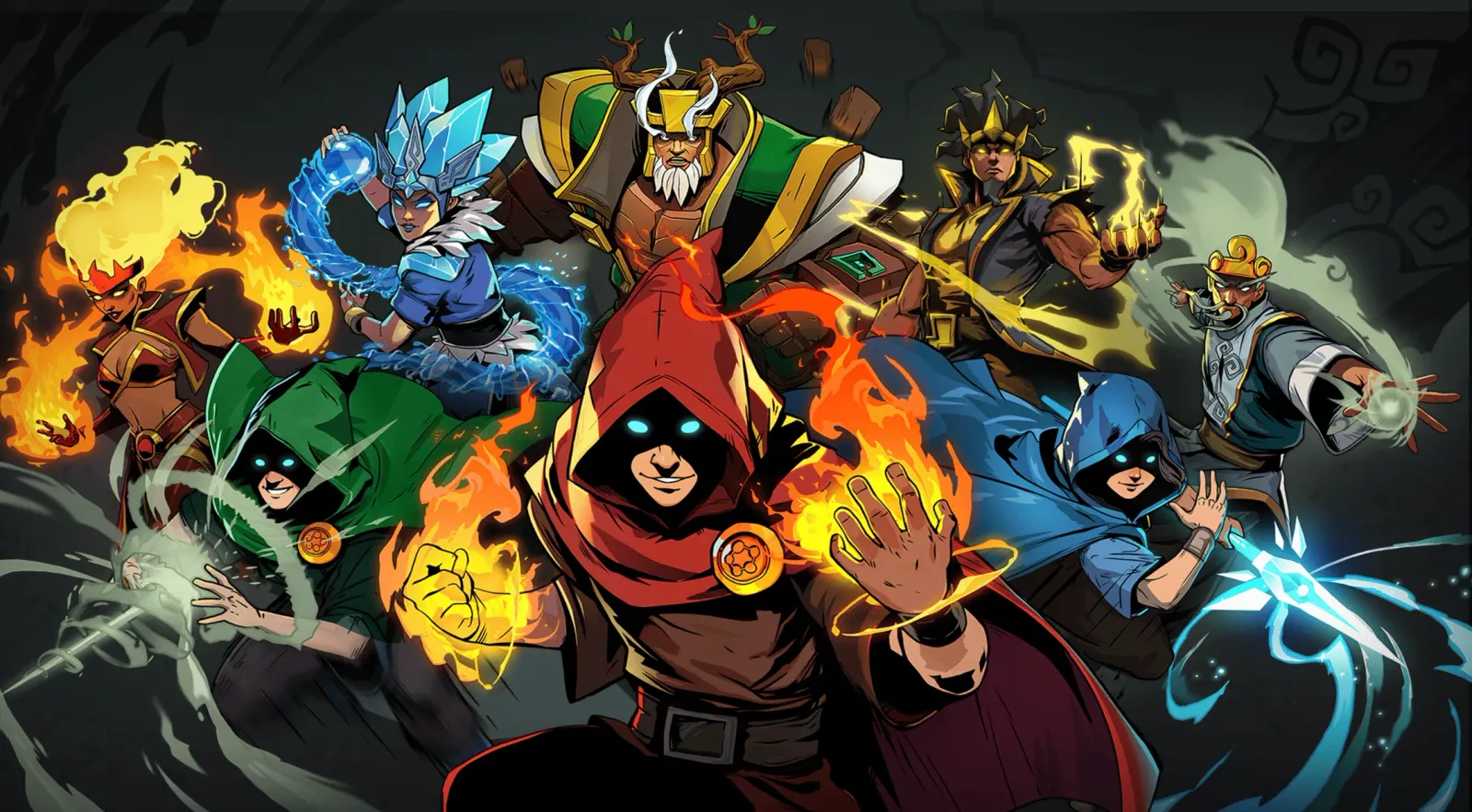
The game’s magic system divides into multiple elemental attributes (fire, ice, lightning, wind, etc.), each with unique color schemes:
- Fire: Orange-red tones with yellow highlights, conveying intensity and explosive power
- Ice: Blue-white tones with crystalline effects, presenting coldness and control
- Lightning: Purple-blue electricity with rapid flashing, emphasizing speed and penetration
- Wind: Green whirlwinds with strong flow, expressing mobility
This clear color differentiation isn’t just aesthetic—more importantly, it allows players to quickly identify various skills and threats during chaotic battles.
Contrast and Readability
Wizard of Legend’s visual design emphasizes game readability. During fast-paced combat, players need to instantly judge:
- Enemy positions and attack warnings
- Their own skill cooldown status
- Dangerous areas on the field
To achieve this goal, the design team employed:
- Red warning markers before enemy attacks
- Subtle halos around player characters to enhance identification
- High saturation colors for important items like health potions and power-ups

Animation and Skill Presentation
Fluid Action Design
Despite being a pixel game, Wizard of Legend’s animation fluidity rivals 2D fighting games. Each skill has complete animation sequences:
- Startup Animation: Lets players feel the charging process
- Release Moment: Strong visual impact paired with screen shake
- Recovery: Seamless action transitions without “stuttering”
Skill Visual Differentiation
With over 100 skills in the game, the design team needed to ensure each skill has unique visual presentation:
Area Skills
- Use diffusing effects to clearly show attack range
- Multi-stage visual changes, like explosion expansion and contraction
Projectile Skills
- Clear trajectory paths
- Impact effects on hit
- Visual differences for varying speeds
Melee Skills
- Rapid movement animations
- After-image effects on swing trajectories
- Hit stop on landing strikes
Combo Visual Feedback
Wizard of Legend encourages players to combine different skills into combos. Visual design supports this gameplay:
- Seamless transition animations between skills
- Accumulated visual effects from consecutive hits
- Special visual presentation for combination moves (like elemental fusion effects)
Series Evolution Design Thinking
Changes from Original to Sequel
Maintained Core
- Foundation pixel style aesthetic
- Clear visual information delivery
- Elemental attribute color system
Upgraded Elements
- More refined pixel density
- Dynamic lighting system
- More complex particle effects
- Environmental background richness
Why Not Full 3D?
Many successful pixel game sequels chose to transition to 3D (like Stardew Valley considered), but Wizard of Legend 2 insisted on pixel style for several reasons:
- Maintain Game Pace: Pixel style allows the game to maintain 60fps fluidity
- Visual Clarity: In chaotic combat, pixel art provides better readability
- Development Efficiency: Small teams more easily create and iterate pixel content
- Brand Identity: Pixel style has become a series trademark
Design Inspiration
Insights for Indie Game Developers
Visual Constraints Can Be Advantages Wizard of Legend proved that constraints (pixel style) don’t mean low quality. Rather, refining within constraints can create unique aesthetics.
Functionality Over Spectacle All visual design serves gameplay. No matter how spectacular effects are, if they impact game readability, they need adjustment.
Consistent Art Direction From characters and scenes to UI, the entire game maintains unified visual style. This consistency strengthens brand recognition.
Technical Implementation Balance
Performance vs. Visual Trade-offs Pixel style allows the game to run smoothly across various platforms, including lower-performance devices like Switch. This expands the potential player base.
Scalability When developing sequels, pixel assets are easier to reuse and modify, reducing sequel development costs.
Comparison with Similar Games
Positioning in Roguelike Genre
Hades: 3D rendering, more realistic visual style Dead Cells: 2D pixel, but leaning toward dark aesthetic Wizard of Legend: Pixel style but vibrant colors, magic theme
Wizard of Legend carved its own visual path, with bright magic effects and crisp combat animations becoming its signature.
Performance in Action Games
Compared to fighting games (like Street Fighter) or action RPGs (like Diablo), Wizard of Legend found the balance between speed and strategy. Visual design supports quick reactions while preserving space for strategic thinking.
Summary
The Wizard of Legend series’ visual design demonstrates “creativity within constraints.” Through carefully designed pixel art, clear color language, and fluid animation, the game created a unique and highly recognizable visual experience.
From original to sequel, the development team showed ability to continuously evolve while maintaining core aesthetics. They didn’t pursue “more modern-looking” 3D graphics, but chose to refine within the pixel art framework.
Key Points:
- Visual design entirely serves gameplay
- Clear visual information delivery is key for fast-paced games
- Technical constraints can transform into unique artistic style
- Consistent art direction strengthens brand identity
For indie game developers, Wizard of Legend proved you don’t need massive art teams or latest technology—with clear visual goals and attention to detail, you can still create impressive visual experiences.
This attitude of “refinement within constraints” is perhaps what makes indie games most captivating.
Related Resources: