Hollow Knight Visual Design Analysis: Peak Achievement in Indie Game Art
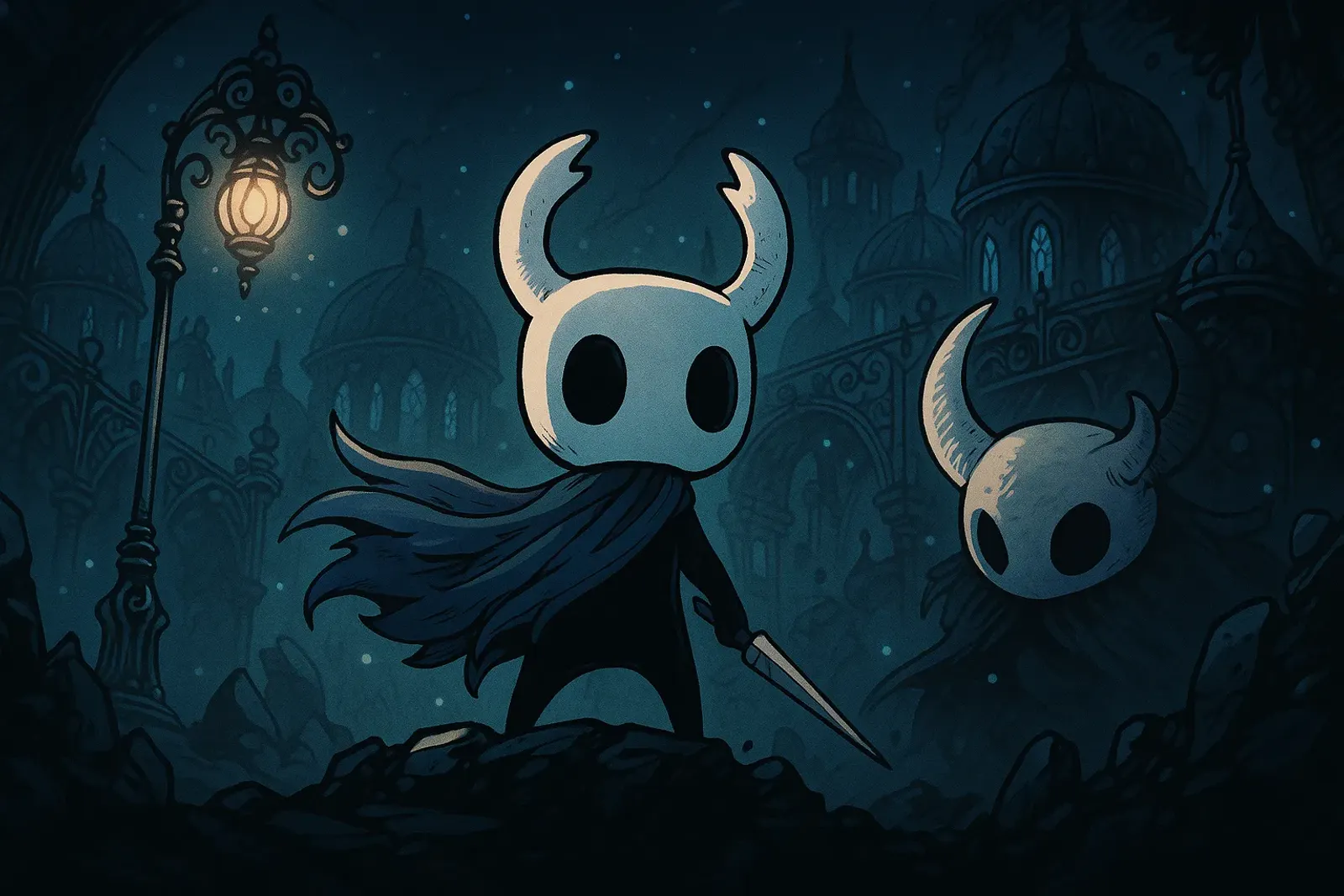
Hollow Knight Visual Design Analysis: Peak Achievement in Indie Game Art
Work Overview
In 2017, a small Australian indie team called Team Cherry—just three people—created a game that would shock the world: Hollow Knight.
This wasn’t a game built on flashy effects or 3D technology. Instead, it used the most traditional hand-drawn 2D art to create an unforgettable underground kingdom.
After launch, the game received critical acclaim and sold over 3 million copies worldwide. Not only did players love it, but its art design became a subject of repeated study in design circles.
Why could a small team’s 2D game have such massive impact?
The answer lies in its visual design.

Design Highlights
Minimal Yet Complex Character Design
The Power of Silhouette
Hollow Knight’s character designs share a common trait—instant recognizability.
The main character, the Knight, has almost no facial expression, is entirely black, with only two white eyes and horns on its head. It looks incredibly simple, but this design is genius because:
- Strong silhouette recognition - Even as a complete shadow, you can instantly recognize the Knight
- Emotional projection space - No fixed expression allows players to project their own emotions
- Clear action readability - Simple design makes combat movements easier to parse
This isn’t laziness—it’s a deliberate design choice.
The Warmth of Hand-drawn Texture
Look closely at character edges, and you’ll notice the lines aren’t perfectly smooth. Some parts are thicker, some thinner, carrying obvious hand-drawn qualities.
This imperfection actually gives characters life. Compared to computer-generated perfect lines, the subtle variations in hand-drawn art bring warmth to the screen.
Diversity in NPC Design
While the entire game world consists of bugs, each NPC has their own personality and story.
From Cornifer the map seller, the mysterious mask vendor, to various area bosses—every character leaves a lasting impression.
Design techniques:
- Use size differences to create visual contrast
- Maintain unified art style while adding unique details
- Actions and postures reflect character personality
Color and Lighting: The Secret to Creating Oppression
The Art of Dark Color Schemes
Hollow Knight’s color strategy is very clever.
Primary tones: Dark backgrounds (black, deep gray, deep blue) occupy over 70% of the screen.
Contrast colors: Small amounts of bright colors (white, blue, purple, green) highlight key points.
This color scheme creates several effects:
- Focus player vision - Bright areas naturally attract attention
- Create oppression - Large dark areas make you feel small
- Highlight danger signals - Enemy red attack warnings are especially obvious
- Save performance - Black backgrounds are rendering-friendly
Color Psychology by Region
Each area has its own theme color, conveying different emotions:
- Greenpath: Soft green, safe haven for beginners
- Fungal Wastes: Purple and pink, eerie and psychedelic
- Crystal Peak: Bright blue and white, ethereal and dangerous
- Deepnest: Deep purple and black, depths of despair
- The Hive: Warm yellow and orange, the only warm zone
These color choices aren’t random—each conveys specific feelings.

Environmental Storytelling: Telling Stories Through Visuals
Stories Revealed Through Scene Details
Hollow Knight’s greatest strength—it barely uses dialogue boxes yet lets you understand what happened to this world.
Look at these details:
- Broken statues and buildings → Once glorious civilization
- Fungus-covered corpses → Plague spreading
- Abandoned mine cart tracks → Once thriving industry
- Wall cracks and claw marks → Battle traces
Walking through each scene, you’re piecing together this world’s history. This is the power of environmental storytelling.
Use of Depth and Parallax
Though a 2D game, Hollow Knight’s scenes have strong spatial sense.
Technical methods:
- Multi-layer parallax scrolling - Foreground, midground, background move at different speeds
- Blur effects - Distant objects slightly blurred to enhance depth
- Size contrast - Massive background buildings contrast with small foreground characters
- Lighting layers - Light sources illuminate foreground, background stays dark
These techniques give 2D screens 3D-like immersion.
Animation Fluidity: The Secret to Smooth Combat
Every Frame is Art
Why does Hollow Knight’s action feel so smooth? Because it’s frame-by-frame hand-drawn animation.
Not using skeletal rigging to distort images, but actually drawing it out frame by frame.
Benefits:
- More natural fluid motion
- Can create exaggerated action deformations
- Stronger impact feeling
Cost:
- Enormous workload
- Requires deep animator skills
But this investment was worth it—smooth actions make combat feel far superior to similar games.
Visual Feedback for Impact
Every attack has clear visual feedback:
- White light effects - Weapon swing trails
- Shake effects - Screen shake when hitting enemies
- Particle effects - Shattered soul fragments
- Sound coordination - Visual and audio synchronization
These details combined make every strike satisfying.
UI/UX: Minimalism Victory
Immersive Interface Design
Hollow Knight’s UI design philosophy: don’t display if you don’t need to.
Most of the time in-game, the screen only shows:
- Health in upper left
- Soul meter in upper right
- Map indicator in lower left
No minimap, no quest lists, no flashy effect frames. The entire screen is clean like a painting.
Icon Design Consistency
All charm, item, and skill icons maintain unified style:
- Black outlines
- Simple symbolic design
- Minimal accent colors
This consistency makes it easy for players to understand each icon’s meaning.
Technical Insights and Inspiration
Small Team Production Wisdom
Hollow Knight was developed by Team Cherry’s three-person team using Unity engine over 3.5 years. All assets are hand-drawn rather than relying on engine defaults, using baked lighting instead of real-time illumination, and employing refined layered scene management to create their unique visual style.
Influence and Inspiration
Core Lessons
Hollow Knight proves: small teams can achieve AAA quality, hand-drawn art never goes out of style, stylization beats realism, and details determine excellence.
Artists can learn:
- Establish strong visual identity - Simple but unique character design
- Master color psychology - Use color to convey emotion and atmosphere
- Focus on animation fluidity - Invest time in animation quality
- Environmental storytelling - Let scenes tell their own stories
- Maintain style consistency - Unified aesthetics from characters to UI
Conclusion
Hollow Knight is an artwork polished by a three-person team over nearly four years, proving the most important truth:
Good visual design doesn’t need the most advanced technology. It needs obsession with details, pursuit of aesthetics, and patience.
Less is more, simplicity is power.
Related Resources:
- Hollow Knight Official Website - Team Cherry’s official site
- Steam Store Page - Purchase and more info
- Team Cherry Development Blog - Development process insights
Tags: #GameArt #IndieGames #HandDrawnStyle #2DGames #VisualDesign #ArtAnalysis